Aegis Legend 5 on the bench, what is measured and what is claimed
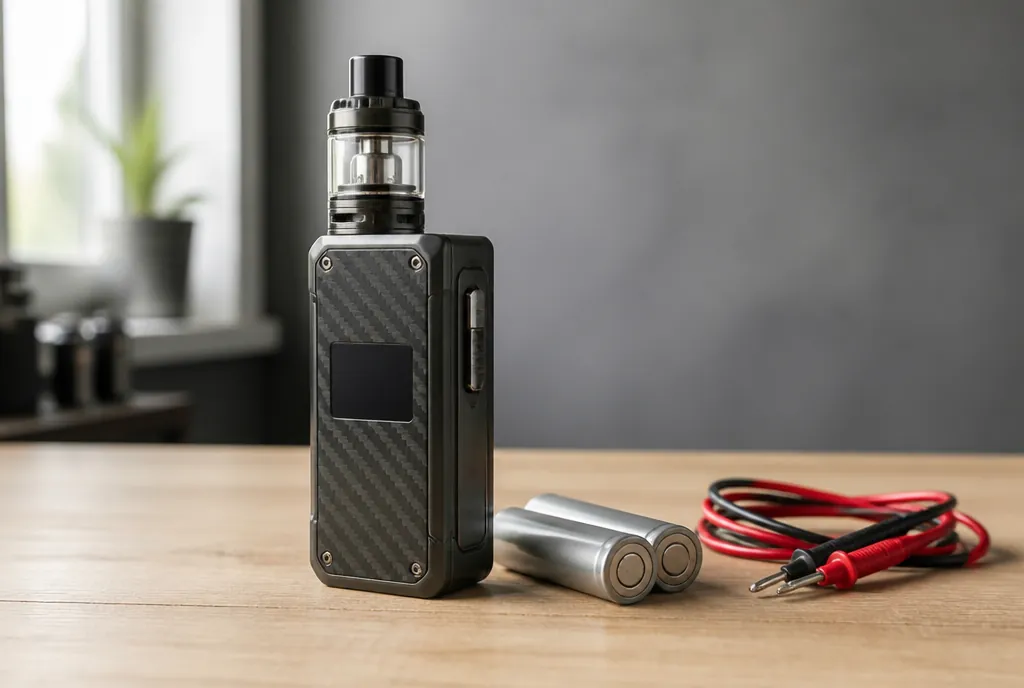
Two retailers, two weights and two sets of dimensions for the same box mod. On the Legend 5 from Geekvape, sources do not agree on the supported resistance range either, and the manufacturer itself publishes two different values. Before scoring anything, a bench therefore has to separate what can be measured from what is merely claimed. This grid draws that line before the first reading, then applies it criterion by criterion to the Aegis Legend 5.
What the Legend 5 actually lets a bench measure
On the Legend 5, six quantities can be measured with a multimeter, a USB tester, a pair of callipers and a set of scales. They are the delivered wattage, the current drawn from the cells, the point at which internal charging stops, chassis heat, dimensions and weight. Three others remain manufacturer declarations, which the bench records without scoring them. Those are the IP68 rating, drop resistance and the firing speed quoted at 0.01 seconds.
What Geekvape publishes, and where its own pages disagree
The official specification sheet lists 5 to 200 W, two external 18650 cells for a nominal 7.4 V, a maximum output current of 45 A, an output voltage capped at 12 V and a resistance range of 0.1 to 2 Ω. It also gives an operating temperature of 0 to 45 °C and a relative humidity range of 45 to 75%, both of which the bench notes at every session.
The trouble starts on the brand’s own shop. Its specification table gives 0.1 to 2 Ω while the description on the same page says 0.1 to 3 Ω, and the pre-installed coil becomes a Z0.15 XM whereas the kit sheet lists a Z0.2 XM. The list of modes changes from one paragraph to the next as well.
The grid lets the device settle the matter. A 2.5 Ω coil, measured cold with an ohmmeter, goes on the mod, and the menu shows whether it is accepted and at what wattage. That observation replaces the competing figures.
The real 200 W window, worked out before it is measured
Two ceilings frame the maximum output, and neither appears on the screen. The arithmetic therefore comes before the reading.
The 12 V ceiling on the coil side
Power follows from voltage and resistance (P = V² / R). With 12 V at most, 200 W is only reachable below 0.72 Ω. At 1 Ω the theoretical ceiling falls to 144 W, and at 2 Ω, the top of the published range, it drops to 72 W. The 45 A current limit sets the other end, allowing 202.5 W at 0.1 Ω.
The two published maxima are therefore consistent with each other. What remains is to check that the mod delivers what the arithmetic allows, by reading the output voltage under load, following the method already applied to the Vaporesso Gen Max and its 220 W.
27 A drawn from the cells at full power
At 200 W, a pack of 7.4 V nominal has to supply around 27 A before circuit losses, and each cell carries that same current because the two are wired in series. Towards the end of a discharge, voltage falls and current climbs accordingly.
With the coils in the kit, the gap is wide. The Z0.2 XM is rated for 70 to 80 W and the Z0.4 XM for 50 to 60 W, so at 80 W the demand drops to roughly 10.8 A. The bench therefore publishes two runs, one on the stock coil and one close to the ceiling, stating the cell model and its declared continuous discharge rating for each.
Charging the Legend 5 to 80%, and how to check it
The mod charges its cells through its USB-C port, and several published tests describe a setting that stops internal charging at 80%. Geekvape’s specification sheet gives neither the charging current nor the exact voltage threshold, so the bench measures both itself.
A USB tester placed between the mains adaptor and the mod records the current drawn. Once the setting has stopped the charge, a multimeter reads the voltage of each cell. The same pair, charged fully on an external charger, serves as the reference, since most lithium-ion 18650 cells are full at 4.2 V.
The voltage gap between the two cells after an internal charge goes into the record too, because it reveals a pair drifting out of balance. The approach mirrors our method for testing a battery charger. Any charge is supervised, on a non-flammable surface.
IP68, what the rating covers and what the bench will not reproduce
The IP code comes from the IEC 60529 standard. The digit 6 means full protection against dust, the digit 8 continuous immersion beyond 1 metre under conditions set by the manufacturer. For its Aegis range, Geekvape quotes immersion to 1.5 metres for 30 minutes and drops from 2 metres.
The rating says nothing about knocks. Impact resistance falls under a separate code, IK, which the product page does not show even though it files shock resistance under IP68. The bench therefore records drop resistance as a marketing claim.
No immersion or drop test is carried out, as it would be destructive with two lithium-ion cells inside. The grid limits itself to the state of the seals and the closure of the battery door.
Dimensions and weight, three sources for one box
Le Petit Vapoteur, a French retailer, lists 89 × 28 × 54 mm and 172 g. Vape Club gives 9.1 cm high, 5.5 cm wide and 2.9 cm deep for 175 g, while the kit drawing published by Geekvape shows 56 mm wide and 146 mm high with the tank fitted. A few millimetres and a few grams are enough to blur any comparison between mods.
The grid therefore measures the bare mod with callipers, then weighs it three times, without cells, with cells and with the empty tank fitted, so that every published figure says exactly what it includes.
The five modes of the AS 4.0 chipset, a variable to lock down
The official sheet lists five modes, ECO, SMART, NORMAL, CUSTOM and TC. The hands-on test published by Taffe-Elec notes that the mod moves from one mode to another as the wattage goes up or down, and that Custom is needed to go below the recommended range. For a bench, that initiative from the electronics is a bias, so every run is done in Custom mode at a fixed, recorded wattage, with the side lighting set and noted.
Scoring grid for the Legend 5 and stated limits
A score is only as good as its weighting, fixed before the bench run so that two dual cell mods scored on this grid stay comparable.
| Criterion | Weight | Status on the Legend 5 |
|---|---|---|
| Delivered wattage against displayed wattage | 25% | Measurable |
| Discharge behaviour and current drawn from the cells | 20% | Measurable |
| Internal charging (current, 80% stop, gap between cells) | 15% | Measurable |
| Heat of the chassis and the cells | 15% | Measurable |
| Interface (modes, A-Lock, screen) | 10% | Observable |
| Dimensions, weight and handling | 10% | Measurable |
| Declared toughness (IP68, drops) | 5% | Declared |
A single unit goes on the bench, with one pair of new, matched cells. Any firmware update triggers a new run, and the score is recalculated with every published run.
What British rules change around the Legend 5
Regulation in Britain lands on the tank and the liquid rather than on the mod itself. Refillable tanks sold in the UK are capped at 2 ml, which is why the kit sold here comes in its TPD version with a 2 ml tank, rather than the 5.5 ml standard edition listed on the manufacturer’s sheet.
Nicotine e-liquid is capped at 20 mg/ml and sold in bottles of 10 ml, a limit that has no bearing on the bench readings but frames every kit on British shelves. Nicotine vaping products are not for sale to anyone under 18 in the UK.
FAQ
These practical questions fill in points the grid deliberately leaves aside.
Does the TC mode on the Legend 5 work with the coils in the kit?
Not in any useful way. Temperature control relies on a wire whose resistance changes markedly with heat, such as nickel, titanium or certain stainless steels. The mesh coils in the supplied tank are Kanthal A1, an alloy whose resistance barely moves, which leaves TC mode without a reference.
Why does the mod suggest a wattage on its own when a coil goes on?
That is Smart mode at work. It reads the resistance of the coil fitted and proposes a wattage range the manufacturer considers suitable. To choose any value between 5 and 200 W freely, switch to Custom mode from the menu.
Does a Legend 5 behave the same way in a British winter?
No. In the cold, a lithium-ion cell gives back less capacity and its voltage sags more under heavy demand, which shortens a measurement run. Below 0 °C the device is outside its stated operating range, and no reading taken in those conditions enters the grid.
How can you tell the A-Lock is engaged without looking at the mod?
By the vibration. The mod vibrates when the side slider locks and unlocks, and it also vibrates to flag a low cell level. Any doubt with the device in a pocket or a bag can be settled by touch.
Is the same tank supplied with every Legend 5 kit?
No. The brand’s shop lists two editions, one with the Z Sub-Ohm 2021 and one with the Z Sub-Ohm Tank 5. The bench notes which one is in the box, along with the coil fitted, before the first run, because every reading depends on the tank and coil fitted.
Related reading
- The test grid for a dual cell mod, applied to the Centaurus Lost Vape
- What the declared 220 W of the Vaporesso Gen Max depend on
- Measuring real current and balance on a battery charger
What the grid keeps from the Legend 5
On the Aegis Legend 5, the grid separates three families of figures. Some are calculated from the sheet, such as the window from 0.1 to 0.72 Ω where 200 W remains reachable. Others are measured, from the 80% charge stop to the real dimensions. The last group, IP68 and drop resistance, remains declarations that the bench flags without scoring.
A spec sheet describes an intention and a bench describes a behaviour, and that difference is what the grid applied to the Legend 5 makes readable from one device to the next.
Editorial content for adult readers only. Nicotine is a highly addictive substance. Nicotine vaping products are not for sale to anyone under 18 in the UK. This article is not a buying recommendation.