Doric 60 Pro: the measurements that separate pods
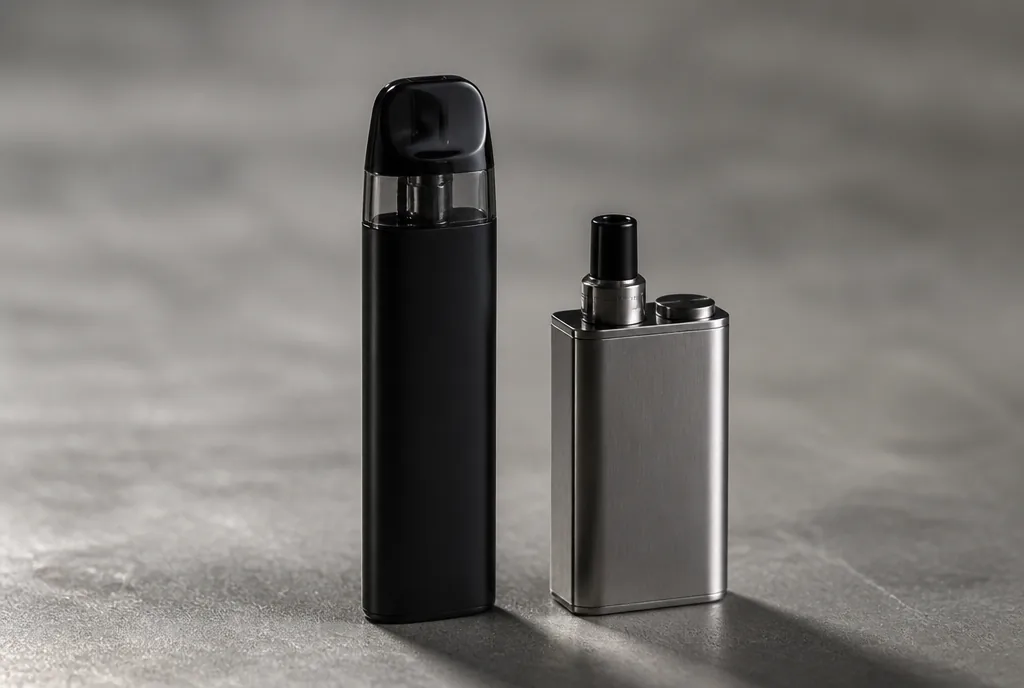
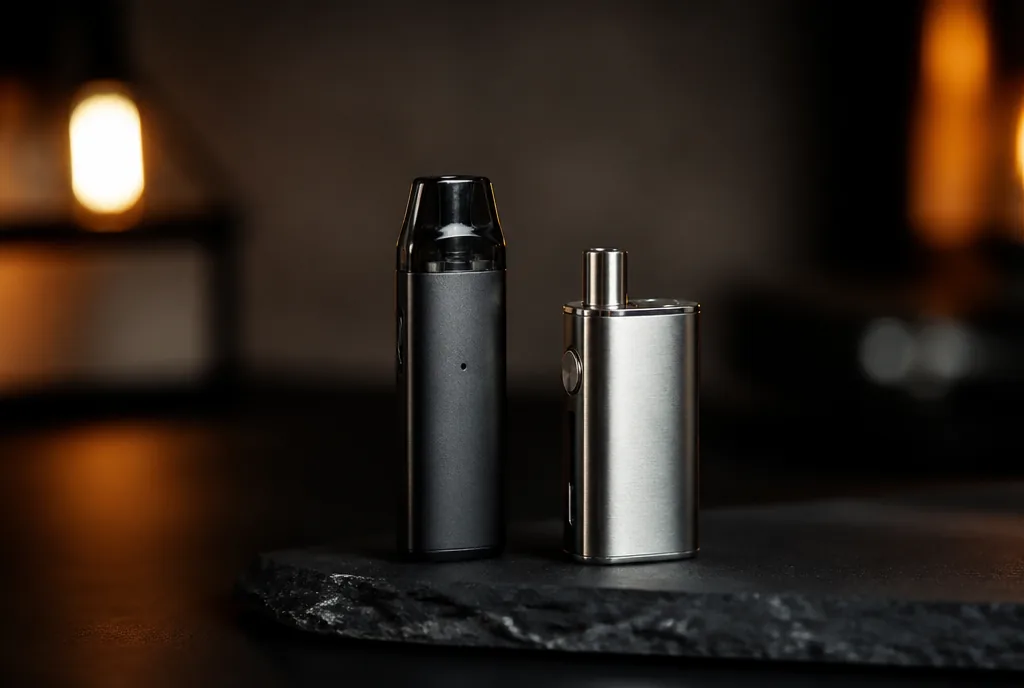
Two pods advertise the same battery capacity and the same tank. One lasts the day, the other does not. The spec sheet never explains why, because it was never designed to. The Doric 60 Pro from Voopoo works well as a case study here: it is a simple tube, well documented on both sides of the Channel, and a legible measurement grid can be laid over it and then reused on any rival.
The five quantities to record on a Doric 60 Pro
Five quantities are enough to separate one tube pod from another, and none of them is printed on the box.
The energy on board, expressed in watt hours rather than in milliampere hours. The consumption per puff, in watt hours, derived from the wattage and the duration. The number of puffs between two charges, counted rather than estimated. The charging current genuinely drawn, measured at the port. And the wattage band each coil can actually be used across, taken on a cold coil and again on a hot one.
The first three are calculated from the manufacturer figures. The last two need an instrument: a plain USB tester for the fourth, a stopwatch and some discipline for the fifth.
What Voopoo declares, and what those figures commit to
Before measuring anything, you need to know what the maker has put on the table. These are not test results, they are declarations, and a protocol handles them strictly as such.
The device is given a 2500 mAh built in battery, a 5 to 60 W range and USB-C charging, figures that British retailers and the Voopoo product page agree on. Two PnP X coils come with the kit, a 0.8 ohm quoted for the low end of the band and a 0.3 ohm quoted for roughly 32 to 40 W, a range that Voopoo and British coil listings both publish.
Those two ranges are the most useful item in the set. They fix the domain in which a measurement means something: outside the band, you are no longer comparing devices, you are comparing settings.
One figure travels badly and has to be handled with care. The international package includes a 5 ml PnP X cartridge, while the kit sold in the United Kingdom ships with a 2 ml cartridge, in line with the British cap on refillable tanks. Any listing quoting the larger figure is describing a kit built for another market, and a bench does not carry that number across.
Physical figures come from published testing rather than from the box. The review issued by Vaping Post in September 2024 records dimensions of 26.1 by 128 mm and a weight of 102 g, which is the sort of detail a retailer page usually omits.
Turning milliampere hours into energy
A capacity of 2500 mAh says nothing until a voltage is attached to it. For a lithium ion cell of this class, the nominal voltage given on the cell datasheet supplies that second term, and capacity multiplied by nominal voltage produces an order of magnitude in watt hours that can be compared across devices.
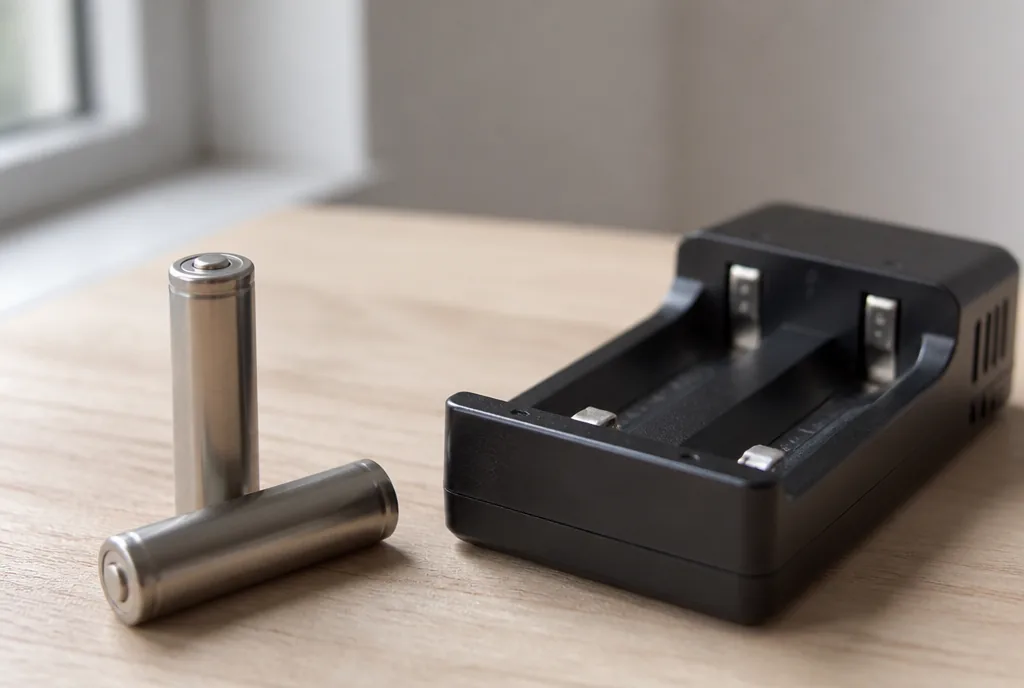
That calculation can be repeated on every pod on the market, and it flattens out spec sheets that looked equivalent while they were quoted in milliampere hours alone. It is also the only honest way to compare an integrated battery against a removable cell, which is why our battery charger protocol starts from the same conversion.
Counting puffs instead of estimating runtime
A runtime quoted in hours or in days is not a measurement, it is an average use case. The protocol replaces it with a count, which is reproducible in the reader’s own hands.
The method comes down to four rules. One coil for the whole session, with no change part way through. A wattage fixed in the middle of the manufacturer band. Puffs of constant duration, timed, with a stable interval between them. And a stop at the first sign of cut-off rather than at the point where it feels weaker.
The result is written as a number of puffs, with the wattage and the duration alongside. Without those two parameters the figure is worth nothing and compares to nothing.
What the coil changes in the reading on a Doric 60 Pro
The same device does not give the same runtime depending on the coil fitted, and the gap is far wider than the one separating two rival pods.
On this kit, Vaping Post records that the 0.3 ohm is markedly hungrier than the 0.8 ohm, and reports getting through a day on the latter without reaching for the charger. That is a tester’s observation, situated in their own use, not a figure to be transposed as it stands: read it as an order of magnitude and nothing more.
A serious bench therefore takes two series, one per coil, and publishes both. Publishing the better one alone describes a device that does not exist.
Measuring the charge: what USB-C does not tell you
A USB-C port names a connector, not a current. Two devices with the same port can draw very different currents, and therefore recharge in very different times.
The reading is taken with a USB tester placed between the source and the device. You note the peak current reached, the moment it starts to fall away, and the current at the end of charge. The curve says more than any total duration, because it shows the point at which the device begins to protect itself.
One quirk of the Doric 60 Pro deserves a line in any protocol: according to the same published test, it cannot be vaped while charging, the maker presenting that block as a safety measure. That constraint rules out running a charge and a session back to back, and forces the readings to be sequenced.
Reading a published score without mistaking it for a measurement
An overall score aggregates criteria that have nothing in common. It orients, it does not measure, and it only compares within the scale that produced it.
The test quoted above awards the pod 4.7 out of 5 and reports an average of 4.6 out of 5 across 53 reader reviews. Those are two different kinds of information: the first is an argued editorial judgement, the second an aggregate of buyer opinion. Mixing them into one ranking produces a table nobody can read.
On our scale, a score takes its place after the measurable quantities, and its weight is stated. The rest is commentary, which is not a fault as long as it is named as such.
What British rules put around this kit
Regulation in the United Kingdom lands on the liquid and the tank rather than on the electronics. Refillable tanks are capped at 2 ml, nicotine containing e-liquid at 20 mg/ml, and those bottles at 10 ml.
That is why the British version of this pod ships with the smaller cartridge, and why a runtime figure lifted from an international review needs checking against the tank actually supplied here. Vaping products are not for sale to under-18s in the United Kingdom.
Frequently asked questions
Does the battery need to be run flat before recharging?
No, and the protocol has no use for that step. A repeated full discharge adds nothing to the reading and tires the cell. The session stops at the first cut-off the device signals.
Can an integrated battery pod be compared with a removable cell mod?
Yes, provided both are reduced to an energy figure in watt hours and the coil and wattage of each reading are stated. Comparing 2500 mAh built in against an 18650 without that step means nothing.
How many puffs make a reading usable?
There is no universal threshold. What counts is running the series through to cut-off, with no interruption and no change of setting, then repeating it at least once to check the two results agree.
Does the weight of a pod enter a score?
It enters comfort of use, not performance. A reading always mentions it, because 102 g in a pocket is not lived the same way as half that, but it does not convert into performance points.
What if the maker publishes no wattage band for a coil?
You reconstruct it by stepping the wattage up in short increments, noting the point where the delivery degrades, then publishing the band you settled on with a note that it comes from observation rather than from the sheet.
Related reading
What the measurement grid changes for the Doric 60 Pro
Taken in that order, the grid turns a spec sheet into a comparable object: energy rather than capacity, puffs counted rather than runtime announced, a charging curve rather than a port type, a coil band verified rather than copied. Applied to the Doric 60 Pro, it separates what Voopoo declares, what a tester observed, and what a reader can check at home, including the tank capacity that differs between the British kit and the international one. It is also the only way to keep a ranking honest over time: when a new device arrives, you do not restart the argument, you fill in the same boxes.
Editorial content for adult readers only. Vaping products usually contain nicotine, a substance that causes addiction. Not for sale to under-18s in the United Kingdom. This article is not a buying recommendation.