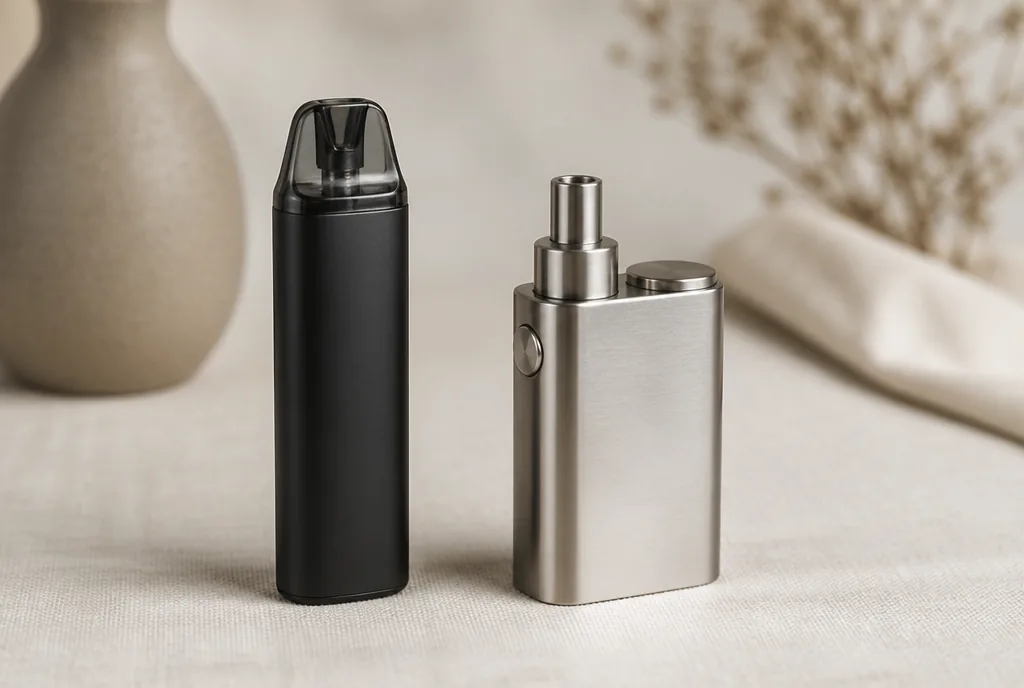
Vaporesso Gen Max: the test grid for a 220 W box
A box advertised at 220 W does not deliver 220 W because that is what the screen says. It delivers them if the cells fitted will supply the current the setting demands, and that condition appears on no product page anywhere. The Vaporesso Gen Max makes the demonstration easy: it is a well documented dual cell chassis whose maximum output does not actually belong to it.
The decisive reading on a dual cell box
On this kind of device, the first quantity to establish is not the wattage on the display. It is the current the setting asks the cells to provide, and that figure is arithmetic rather than instrumental.
Two 18650 cells in series present a pack voltage of roughly double that of a single cell, and the nominal figure for a lithium ion cell comes from the datasheet that its maker publishes. Divide the wattage of the setting by that pack voltage and you have the current the pair has to deliver continuously. The calculation takes ten seconds and can be repeated for any setting on the dial.
That value, and not the number on the chassis, decides what the device can genuinely do. Everything else in the protocol follows from it.
We publish no cell pairing as suitable for a given setting, and no reader should treat a figure taken from a review as clearance for the cells in their own hand. What a bench publishes is how to read a cell datasheet: find the exact reference, locate the continuous discharge rating and the maximum charge figures, and compare those against the demand you have just calculated. When the demand runs past what the sheet describes, the setting is outside the working range of those cells, whatever the display is willing to show.
What Vaporesso declares on the Gen Max
A bench begins by copying out the declarations cleanly, dated and attributed. On this kit they are complete and they cross-check well, with one exception.
The listings agree on a 5 to 220 W range, a 0.96 inch colour TFT screen, USB-C charging, a 510 connection and an 810 drip tip. The two 18650 cells are not supplied, which is itself part of the story: the maker ships the chassis and leaves the decisive component to the buyer.
The kit arrives with the iTank T and two GTi mesh coils, a 0.2 ohm and a 0.4 ohm, each carrying its own wattage band printed by Vaporesso. Independent testing has credited the chassis with accurate wattage and voltage regulation, which is a claim a bench can verify rather than repeat.
One tank figure travels badly. International listings quote the iTank T at a capacity well above what British regulation allows, while the version sold in the United Kingdom is supplied at the 2 ml cap that applies to refillable tanks here. A listing advertising the larger figure is describing a kit built for another market, and the number is not carried across.
The list of vaping modes is the exception mentioned above. One published review cites Eco, Pulse and Smart, while a retail listing for the same device gives Pulse, F(t) and Smart, both crediting the Axon chipset. That kind of gap is settled on the device, by photographing the menus, not by choosing the source that fits the argument. A report publishes the list it observed and flags the listing that differs.
Verifying that the Vaporesso Gen Max can reach 220 W
The maximum figure on a box describes a capability of the circuit, not a promise of operation. The protocol consists of holding that figure up against the cells actually installed.
The approach is the one set out above. Read the continuous discharge rating printed on the wrap and confirm it against the maker’s datasheet, calculate the current the target setting demands, and compare the two. Where the demand exceeds what the sheet allows, the setting falls outside the working domain of those cells, and the bench caps its reading there and says so rather than pushing the box to its theoretical maximum.
That situation is common rather than exotic, because a chassis of this class is regularly bought alongside cells chosen on price. It is exactly why a review has to publish the reading method instead of a comfortable number.
Measuring delivered power rather than requested power
Between the setting entered and the energy that arrives at the coil sit the efficiency of the circuit and the voltage sag of the cells. Those two together are what the next reading isolates.
The series is run at a fixed setting, on a coil whose cold resistance has been measured. You note the displayed wattage, the voltage across the coil at the end of the puff, and the state of charge shown at the start and end of the run. Comparing successive settings reveals the level at which the device starts to fall short of its own display.
A bench runs that series twice, once with each of the two supplied coils, because they do not load the circuit in the same way. Publishing a single series on a Vaporesso Gen Max describes half the device and presents it as the whole.
The points no instrument measures
A complete protocol keeps a place for observations of use, on the strict condition that they are never presented as measurements.
Published testers have noted a rotary switch that is stiff to turn and hard to operate with the thumb, and a flavour delivery judged a step behind the previous generation of the tank, with the top mounted airflow limiting leaks in exchange. Those are situated observations, made by identified people, on individual samples.
They belong in a bench report, in a section of their own, with attribution. Mixed into the numbers they would borrow an authority they do not have, and that is how a review turns into marketing without anyone deciding to do it.
Charging a Vaporesso Gen Max: internal against external
A chassis with removable cells offers two charging routes, and the two are not equivalent.
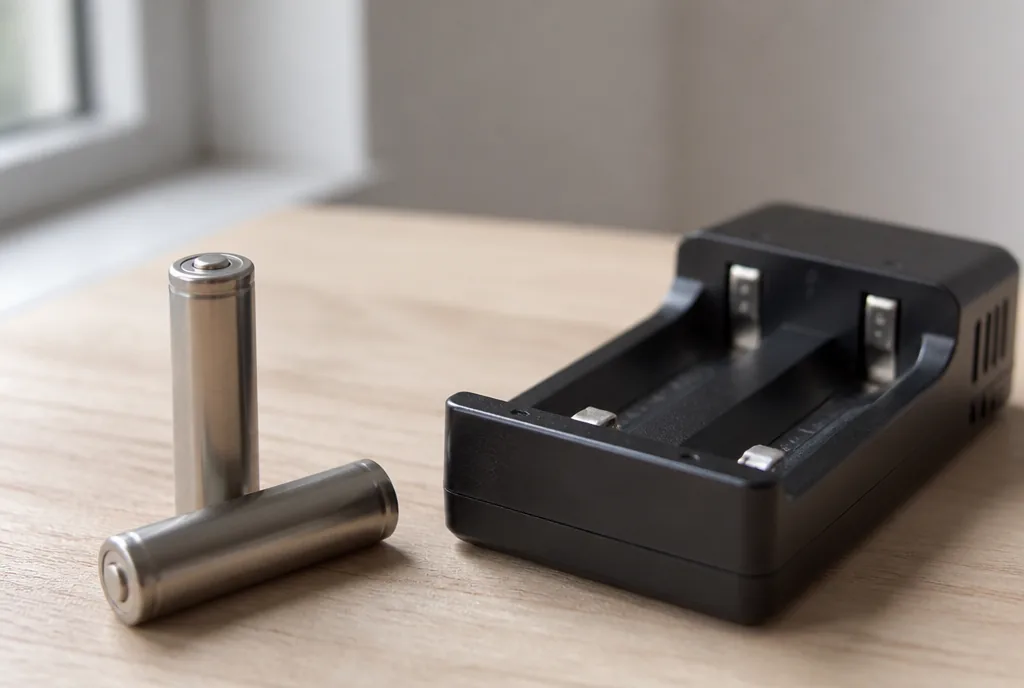
On the USB-C port, the current is shared between the two cells, which lengthens the time compared against an external charger where each cell has its own circuit. The reading is taken with a USB tester, noting the peak current, its decline and the end of charge, and the same session is then repeated on the external route with the same pair.
That comparison is one of the most telling readings in this whole protocol, and it applies to any removable cell hardware. We set it out in full in our method for testing a battery charger.
Cell habits that frame every reading
The pair fitted is matched: same reference, same capacity, same charging history. Cells travel in a dedicated case, never loose in a pocket with keys or coins, and never in the chassis when the device is packed away for a journey.
A wrap that is torn, lifting or discoloured means the cell is retired before the next use, not monitored to see whether it worsens. Charging happens on a unit built for that chemistry and that format. Those habits are the entry condition for a valid reading, not an afterthought appended to one.
Frequently asked questions
Do the two cells in a dual box need to be matched?
Two cells of the same model, the same age and the same state of charge behave more consistently in series. A serious report records the reference and the history of both, otherwise two sessions are not describing the same configuration.
Does temperature control mode belong in the protocol?
It gets a series of its own, never mixed with the variable wattage series, because it changes the quantity being controlled. A reading in watts and a reading in degrees do not compare.
How do you measure the real capacity of a tank?
On the scales, weighing the tank empty and then filled to the recommended line, and converting the difference in mass into a volume using the base ratio in use. The dead volume around the chimney explains the gap with the declared figure.
Does a colour screen affect the results?
No, but it draws current, and that draw lands inside the runtime reading. It is one more reason to count puffs at a fixed setting rather than quote a duration in hours.
Should a device be tested with the cells sold in a bundle?
Yes, to reproduce the buyer’s experience, and then a second time with cells whose datasheet covers the setting under test. The two series are announced separately and never averaged together.
Related reading
- Centaurus Lost Vape: the test grid for a dual cell mod
- Q16 Pro: the test protocol for a constant voltage kit
What the bench keeps from the Vaporesso Gen Max
The grid applied to the Vaporesso Gen Max gives a stable reading order: first the current a setting demands and what the cell datasheet actually describes, then the delivered power setting by setting and coil by coil, then the weighed capacity of the British tank and the charging curve, and finally the observations of use, clearly separated and attributed. The figure of 220 W is not false, it is conditional, and that is precisely the kind of nuance a product page cannot carry. Vaping products are not for sale to under-18s in the United Kingdom, and a bench report is not a purchase recommendation.
Editorial content for adult readers only. Vaping products usually contain nicotine, a substance that causes addiction. Not for sale to under-18s in the United Kingdom. This article is not a buying recommendation.