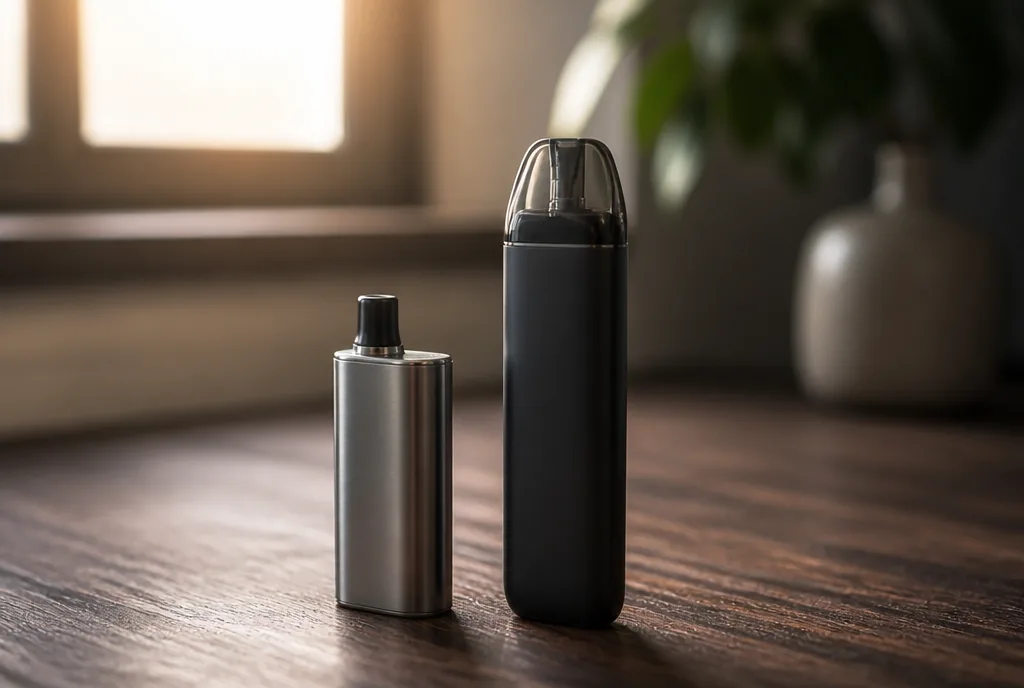
Vaptio Cosmo 2: what we measure on a small pod
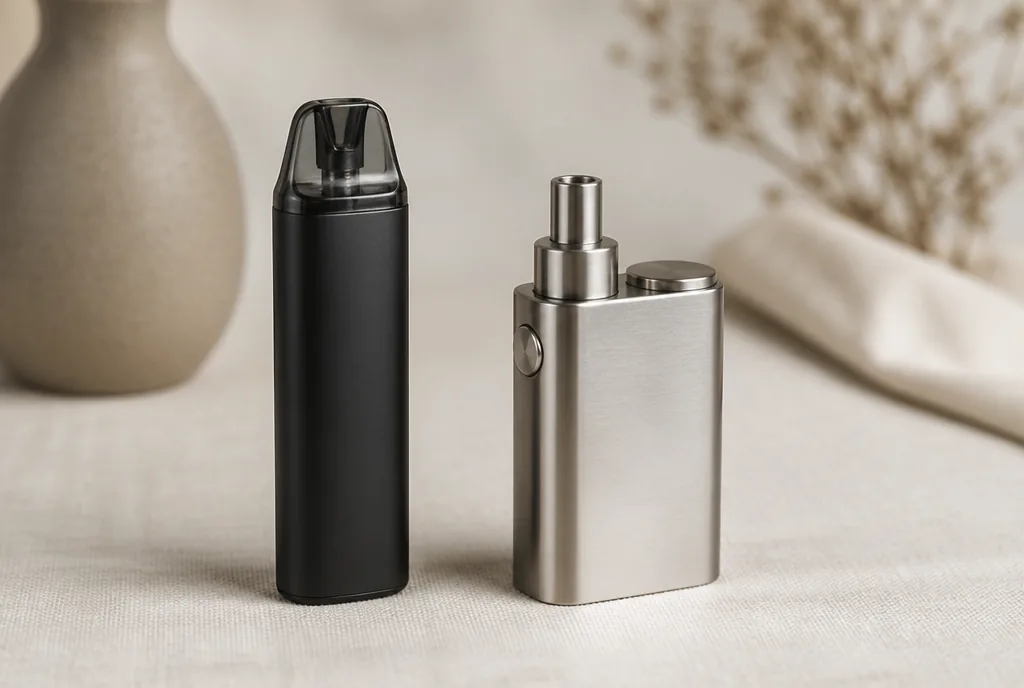
A device that offers three power levels without ever displaying a watt hands the tester a concrete problem: what goes in the wattage column? The Vaptio Cosmo 2 belongs to that family of deliberately simplified kits, where the user picks a step rather than a value. That is exactly what makes it a good protocol exercise, because it forces you to measure instead of copy.
The four readings that describe a Vaptio Cosmo 2
On a compact pod adjusted by steps, the grid narrows to four points, and all four can be taken on a kitchen table.
The real wattage delivered at each step, derived from the voltage and the resistance. The usable capacity of the tank, measured by filling rather than read off a listing. The number of puffs between two charges, at a fixed step and a constant puff duration. And the physical dimensions, checked with a vernier caliper rather than lifted from the description.
None of that needs an expensive bench. The only slightly specific instrument is an ohmmeter able to read a vaping coil; the rest is a set of scales, a caliper and a stopwatch.
The declared figures and their status
An honest protocol separates what is declared from what is observed. Here is the first column, the declarations, as British and European retail listings publish them.
The kit is given a 2000 mAh built in battery, a 1 to 25 W range, three named levels rather than a numeric setting, a 2 ml pyrex tank filled from the top, adjustable airflow, a 510 drip tip and USB-C charging. Two coils accompany the kit, a C5 at 1.0 ohm and a C6 at 0.70 ohm, with the wider C1 to C6 family remaining compatible.
A light indicator completes the set: it turns red below roughly 30 percent of remaining charge and stays blue above it. That is binary information, not a gauge, and a runtime reading cannot lean on it in any way.
The dimensions are where the listings come apart. The same sheet gives a length of 27.3 mm, a width of 22 mm and a height of 130 mm, and those three numbers describe an object far taller than the photographs of the kit show. One of them is almost certainly a value carried over from another model.
That is the kind of anomaly that propagates from shop to shop without anyone stopping it. A bench flags it, measures the object itself, and publishes its own figure with a note that it diverges from the listing. It is less dramatic than a verdict, and it is the heart of the work.
Measuring the real wattage of three unlabelled steps
When no screen shows a watt, the wattage is derived. Ohm’s law is enough: power is the square of the voltage divided by the resistance, provided both terms are known.
The protocol runs as follows. Measure the cold resistance first, on an ohmmeter, because the printed value is a nominal figure carrying a tolerance. Then record the voltage delivered at each step, across a known load, and calculate the corresponding wattage. Three steps give three values, which are published together with the resistance used.
The result is valid for that resistance only. Fitting the 1.0 ohm coil in place of the 0.70 ohm changes all three wattages without the user touching anything at all. That is the piece of information no marketing description ever provides, and it explains most of the disappointment reported in use.
Checking the tank capacity of a Vaptio Cosmo 2 rather than believing it
Two declared millilitres are never two usable millilitres. Between the maximum fill line, the dead volume around the chimney and the reserve soaked into the wicking, the gap is systematic.
The measurement is taken on the scales, not with a syringe. Weigh the tank empty, fill to the recommended level, weigh again, and convert the difference in mass into a volume using the density of the liquid, which depends on its base ratio. The method requires that ratio to be noted, otherwise the calculation is simply wrong.
On a 2 ml tank, a difference of a few tenths of a millilitre is a meaningful share of the contents, and it translates directly into the number of refills across a day. That 2 ml figure is also the cap that applies to refillable tanks sold in the United Kingdom, so the British kit and the international one agree here, which is not the case on every device we put on the bench.
What a declared coil life is actually worth
Product listings usually settle for a generic range. The one repeated for this device puts coil life somewhere between two and three weeks, attributing the estimate to manufacturers in general.
That range is not a measurement. It states neither the wattage, nor the volume of liquid passed, nor the base ratio. A bench replaces it with a verifiable quantity: the volume of liquid consumed before the delivery degrades, expressed in millilitres. That is reproducible, it compares between devices, and it does not depend on anybody’s personal rhythm.
The reading is taken on a new coil, at a fixed step, recording the cumulative refills up to the point where the delivery clearly changes. That cumulative figure is published with the base ratio alongside it, and the same discipline applies to the tube pods we test on the same grid.
Where this pod sits under British rules
Regulation in the United Kingdom lands on the liquid and the tank rather than on the electronics of a compact pod. Refillable tanks are capped at 2 ml, nicotine containing e-liquid at 20 mg/ml, and those bottles at 10 ml.
A coil life reading therefore has to state which strength and which base ratio were in the tank, because both change how quickly the wicking degrades. A runtime figure taken from an international review of a larger tank version does not transfer to the kit sold here.
Vaping products are not for sale to under-18s in the United Kingdom, and that rule covers the coils and accessories sold alongside them.
Frequently asked questions
Can a pod be tested with a different liquid at each session?
No, that invalidates the comparison. The base ratio and the flavour loading change how the wicking soaks and how the coil degrades. A bench fixes a reference liquid and keeps it from one session to the next.
Should you wait between puffs during a reading?
Yes, and the interval has to be stated. Puffs taken back to back raise the temperature of the coil, which changes the delivery and distorts any comparison with a device tested more slowly.
Does the tolerance on a coil value change the result?
It can change it appreciably, especially on low values. That is exactly why the resistance is measured cold before every series instead of the printed value being reused.
How do you test adjustable airflow reproducibly?
By identifying the two extreme positions, then working from intermediate positions that are marked, noted and photographed. Without a physical reference point, two sessions are not describing the same setting.
Does the retail listing belong in a measurement protocol?
The listing is recorded as a source, dated, and used only for the declarations it makes. Anything that moves over time is kept out of the measurement columns and mentioned separately, because a declaration changes and a measurement does not.
Related reading
- Q16 Pro: the test protocol for a constant voltage kit
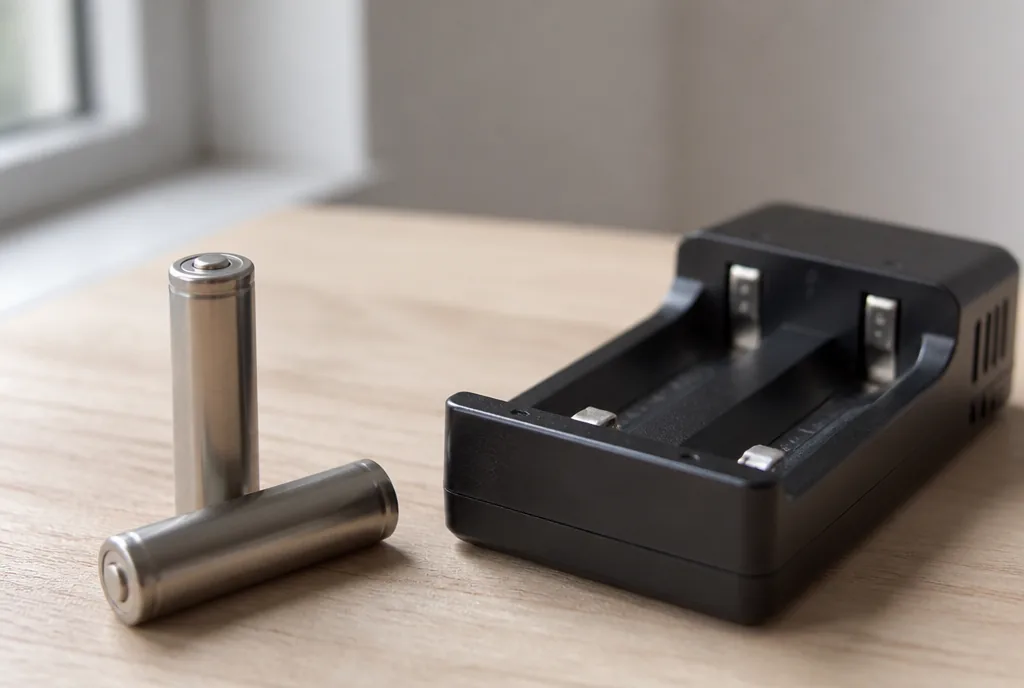
- Battery charger: measuring real current and balance
What a bench run adds on the Vaptio Cosmo 2
A simplified pod is not an easy pod to test: the fewer values it displays, the more the measurement work carries. On the Vaptio Cosmo 2, the grid comes down to three reconstructed wattages, a weighed capacity, verified dimensions and a coil life expressed in millilitres rather than in weeks. None of that demands a laboratory, and all of it can be cross-checked by a reader at home with an ohmmeter, a set of scales and a caliper. It is the same demand we place on the multi cell boxes with large colour screens, where the sheer abundance of displayed information creates precisely the opposite problem.
Editorial content for adult readers only. Vaping products usually contain nicotine, a substance that causes addiction. Not for sale to under-18s in the United Kingdom. This article is not a buying recommendation.