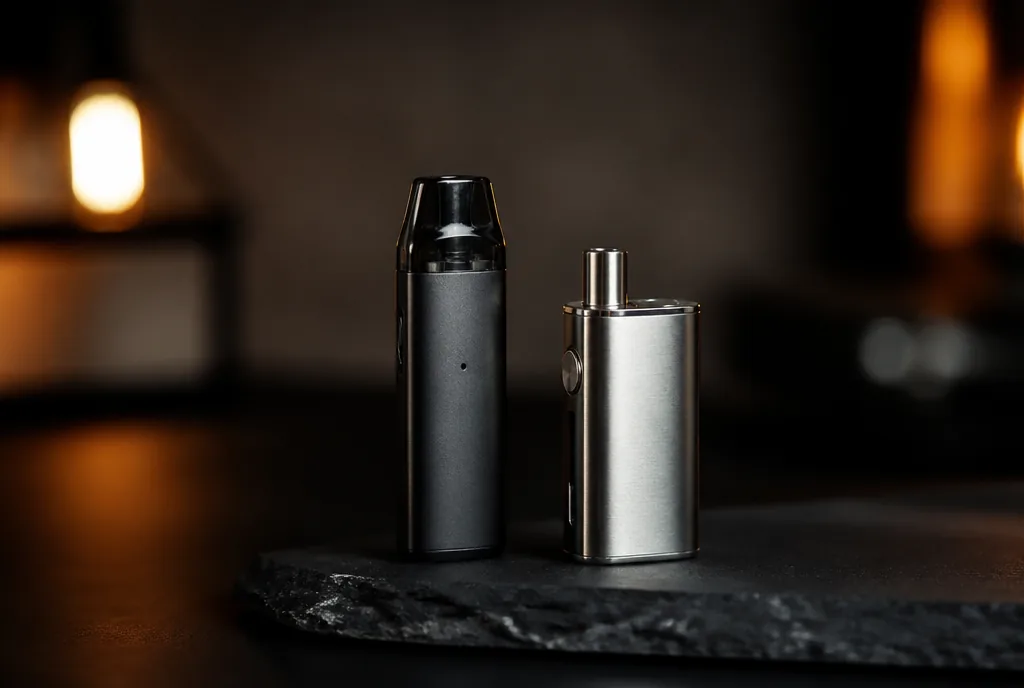
Geekvape Soul 2 on the bench, sorting the figures before measuring
More than a centimetre of difference in height, two battery capacities and two wattage ranges for the same device. The Geekvape Soul 2 has not reached the bench yet and its spec sheets already contradict each other. A 35 W pod kit ought to be easy to describe. Before the first reading, the grid therefore has to sort what the manufacturer and retailers publish, keep what can be measured and set aside what can only be claimed.
Geekvape Soul 2, the spec sheet the bench starts from
The Geekvape Soul 2 is a pod kit with a built-in 2100 mAh battery, capped at 35 W, that takes pods with built-in 1.0, 0.6 and 0.4 Ω coils. These are the values the grid starts from, with where each one comes from.
| Feature | Value kept | Source |
|---|---|---|
| Battery | 2100 mAh, built-in | Manufacturer |
| Maximum output | 35 W, above 30 W with the 0.4 Ω pod only | Manufacturer |
| Pods | 1.0 Ω and 0.6 Ω supplied, 0.4 Ω sold separately | Manufacturer |
| Capacity | 2 ml top-fill in the UK, 4 ml elsewhere | UK retailers, manufacturer |
| Screen | 0.99 inch, hidden at rest | Manufacturer, a UK retailer |
| Activation | Button or auto-draw | Manufacturer |
| Charging | USB-C, 5 V and 2 A, 40 minutes claimed | Manufacturer, a UK retailer |
On this device, five quantities can be measured with an ohmmeter, a USB tester, a pair of callipers and a set of scales. They are the real resistance of each pod, the current and duration of a recharge, the dimensions, the weight and the voltage delivered at each wattage step. Three points remain declarations that the bench records without scoring them, namely the patented leak-proof design, pod lifespan and a battery life expressed in days.
Three Soul 2 figures that do not add up
The manufacturer’s sheet, retailers and published reviews describe the same device with different values. Three gaps are enough to skew any comparison with another pod kit unless someone settles them.
Dimensions and weight
Geekvape’s official store lists 23.5 × 33.67 × 108.49 mm. Two other sources, a French retailer’s product page and the review published by Vaping Post, give 119.46 × 26 × 17.99 mm. The gap reaches almost 11 mm in height and more than 7 mm on another dimension, far beyond rounding. The weight, missing from the official sheet, is given as 90.5 g in a retailer’s comparison and 91 g in the review.
Battery capacity
The 2100 mAh figure is shared by the manufacturer and by retailers. One retailer’s comparison nonetheless shows 2500 mAh in its table and 2100 mAh in its text. The grid keeps the official figure and measures the energy actually drawn during a recharge.
Wattage range
The 35 W maximum is consistent from one source to the next, but the manufacturer states that only the 0.4 Ω pod goes beyond 30 W. The same published review gives 5 to 35 W in its spec table and 5 to 30 W in its FAQ, which in fact matches the pods supplied in the box.
Geekvape Soul 2 wattage, pod by pod
Smart mode on the Geekvape Soul 2 sets the wattage from the pod fitted. Two retailers, one French and one British, agree on the ranges, with 15 to 30 W for the 0.6 Ω, 5 to 15 W for the 1.0 Ω, and 30 to 35 W for the 0.4 Ω sold separately. Since voltage and current follow from power and resistance (V = √(P × R) and I = √(P / R)), the top of each range translates into values that can be checked.
| Pod | Stated range | Voltage at the top | Current at the top |
|---|---|---|---|
| 1.0 Ω | 5 to 15 W | 3.87 V | 3.87 A |
| 0.6 Ω | 15 to 30 W | 4.24 V | 7.07 A |
| 0.4 Ω | 30 to 35 W | 3.74 V | 9.35 A |
These figures assume a resistance exactly matching its marking. The bench therefore measures every pod cold with an ohmmeter before setting the wattage, then reads the voltage under load at the chosen step, as it did for the Vaptio Cosmo 2 and its small pods.
USB-C charging and the claimed 40 minutes, how to check them
The official sheet claims a full charge in 40 minutes and talks of a week of use per charge. The manufacturer’s blog and a British retailer agree on a USB-C input of 5 V and 2 A, which means 10 W at most on the adaptor side.
The USB tester, placed between the mains adaptor and the device, records the current drawn, the cumulative energy in watt-hours and the time at which charging stops. A device that is full in 40 minutes should show a current close to 2 A for most of the charge, then a clear taper at the end of the cycle.
Battery life in days depends on each person’s pace and on the pod fitted. It does not enter the grid, which publishes instead a number of fixed-length activations at a recorded wattage. The method follows our test of a battery charger, and every charge is supervised.
Soul and Soul 2 pods, compatibility tested both ways
Two French retailers state that pods from the original Soul and from the Soul 2 swap between the two devices, with one exception, the 0.4 Ω, which is reserved for the Soul 2. The official sheet says nothing about this, and the British product pages consulted are silent on it too.
One of those retailers rates the original Soul at 1500 mAh and 30 W, which fits with the 0.4 Ω pod, designed for 30 to 35 W, being kept away from the older device. The grid therefore fits every pod into each of the two devices, notes the resistance shown on screen and checks for leaks after an hour standing upright.
Pod capacity in Britain, the 2 ml version
The manufacturer’s sheet describes a 4 ml side-fill cartridge, a version that cannot be sold in Britain. Refillable tanks and pods sold in the UK are capped at 2 ml, and two British retailers list the Soul 2 with 2 ml top-fill pods, the 0.6 Ω pre-installed and a 1.0 Ω spare. The bench notes the exact version received before any reading, since capacity and the position of the fill port change how the wick takes up liquid.
Nicotine e-liquid in the UK is capped at 20 mg/ml and sold in 10 ml bottles, a limit with no bearing on the bench readings.
Hidden screen and dual activation, what the grid observes
The 0.99-inch screen stays invisible at rest and lights up on activation, showing remaining charge, wattage, resistance and a puff counter. The review quoted above finds it too dim outdoors. The grid therefore records its legibility under three kinds of light, indoors, in shade and in full daylight.
Activation works by button or by auto-draw, and the airflow control covers a tight draw as well as a looser one. These settings are fixed and recorded before each run, as with the Doric 60 Pro, another pod kit on the bench.
Scoring grid for the Soul 2 and stated limits
The weighting is fixed before the bench run, so that two pod kits scored on this grid stay comparable.
| Criterion | Weight | Status on the Soul 2 |
|---|---|---|
| Delivered wattage against displayed wattage, per pod | 25% | Measurable |
| Recharging (current, duration, energy drawn) | 20% | Measurable |
| Real pod resistance and Soul compatibility | 15% | Measurable |
| Leaks after filling and resting | 15% | Observable |
| Screen, activation and airflow | 10% | Observable |
| Dimensions, weight and handling | 10% | Measurable |
| Patented leak-proofing and pod lifespan | 5% | Declared |
A single unit goes on the bench, with new pods of each value. Any firmware update triggers a new run.
FAQ
These practical questions deal with using the device, which the grid deliberately leaves aside.
Which mains adaptor should charge the Soul 2?
No adaptor is supplied. With the input stated as 5 V and 2 A, a USB-C adaptor able to deliver 10 W covers the need, and a more powerful one will not push the device beyond what it accepts. Charging should be supervised, on a clear surface.
Should a new pod be left before first use?
Yes. Once the pod is filled, letting the wick soak for a few minutes before the first activation avoids heating dry cotton. Starting at the bottom of the wattage range also lowers the risk of a burnt taste.
Why does the screen show nothing when the device is put down?
That is by design. The screen sits under the shell and only lights up during activation or while settings are being changed. A blank screen at rest is therefore not a sign of a flat battery.
Can the Soul 2 be used for direct lung vaping?
Only in part. The manufacturer presents it as designed for mouth-to-lung and restricted direct lung vaping, looser but a long way from a sub-ohm tank on a box mod. The 0.4 Ω pod, run between 30 and 35 W, comes closest.
Why does only one unit go on the bench?
Because the grid compares models, not production batches. A second unit would only be measured if the first strayed clearly from the stated values, for instance a pod outside its tolerance, so as to tell an isolated fault from a design gap.
Related reading
- The test grid applied to the small Vaptio Cosmo 2 pod
- The measurements that separate pods, the Doric 60 Pro case
- Measuring real current and balance on a battery charger
What the grid keeps from the Geekvape Soul 2
On the Soul 2, the grid separates three families of figures. Some are calculated, such as the 9.35 A drawn at the top of the range by the 0.4 Ω pod. Others are measured, from the real dimensions to the recharge time claimed at 40 minutes. The last group, leak-proofing and pod lifespan, remain promises that the bench flags without scoring.
A spec sheet describes an intention and a bench describes a behaviour, and this prior sorting is what makes the Geekvape Soul 2 comparable with the other pod kits run on this grid.
Editorial content for adult readers only. Nicotine is a highly addictive substance. Vaping products are not for sale to anyone under 18 in the UK. This article is not a buying recommendation.